Major Players in Active Climate Control Systems by Admin

What is Active Climate Design?

As the name implies, active climate control systems operate on the opposite principle of passive climate design. Instead of relying solely on building orientation, thermal mass, or natural ventilation, active systems consume power to directly modify thermal comfort and indoor air quality (IAQ).

Key Characteristics of Active Systems

Active systems generally share four core traits:

  1. Purchased Energy Dependency: They require external energy inputs (electricity, natural gas, fuel oil, or propane) to operate.

  2. Dedicated Mechanical Components: They rely on single-purpose mechanical equipment such as pumps, fans, compressors, and burners.

  3. Envelope Integration: Highly effective active design is well-thought-out and tightly integrated with the building envelope rather than added as an afterthought.

  4. Specialized Engineering: They are typically engineered by specialized MEP (mechanical, electrical, plumbing) consultants rather than solely designed by the architect or builder

Primary Heating Equipment

The acronym HVAC (Heating, Ventilation, and Air Conditioning) encompasses these mechanical strategies. Below are the primary heat sources and distribution mechanisms driving active climate control.

Furnace: it is a closed unit that uses combustion or electric resistance to heat air. In a residential setting, the equipment burns gas, propane, fuel oil or uses electric resistance to generate the heat source

Boiler: it is a closed metal vessel that heats water or generates steam to serve as the hydronic heating medium.

Unlike heat pumps—whose efficiency and output drop as outdoor air temperatures plummet—furnaces and boilers deliver consistent heat output regardless of the outdoor temperature. Because they generate heat directly through combustion (or electrical resistance) rather than relying on refrigeration cycle, they have no minimum operating temperature cutoffs limits when performing their jobs. ( Occasionally, furnaces or boilers might experience frozen pipes or vent icing during extreme weather, which can disrupt smooth operation.)

Major Cooling Mechanism

The fundamental challenge of active cooling is pumping heat out of cooler indoor space and rejecting it into warmer outdoor environment. The HVAC industry relies on several primary mechanisms and equipment configurations to achieve this.  

Vapor Compression Refrigeration Cycle: The core thermodynamic process driving mechanical cooling. In central plant systems, it acts as a thermal bridge between a chilled water loop (which absorbs indoor heat) and a condenser water loop (which rejects heat outdoors).

Direct Expansion (DX) vs. Variable Refrigerant Flow (VRF):

  • Direct Expansion (DX): Delivers cooling directly as indoor air passes across an evaporator coil containing circulating refrigerant. Their evaporate coil can be located only 100 ft or so from the compressor or system.

  • Variable Refrigerant Flow (VRF): A flexible DX system where one outdoor compressor/condenser unit feeds multiple individually controlled indoor evaporators. This arrangement is similar to that found in ductless mini-split systems, where single outdoor unit can be used with several evaporator units.

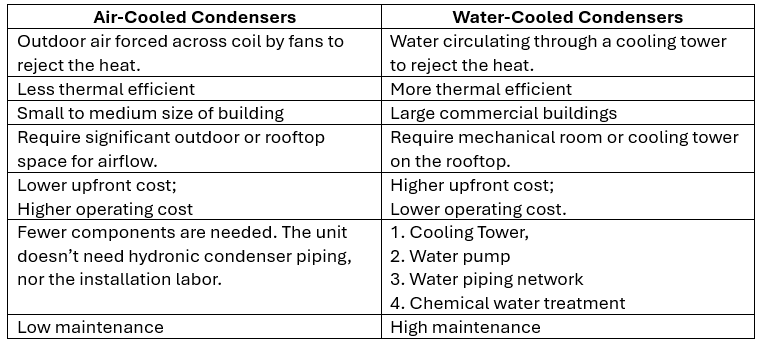
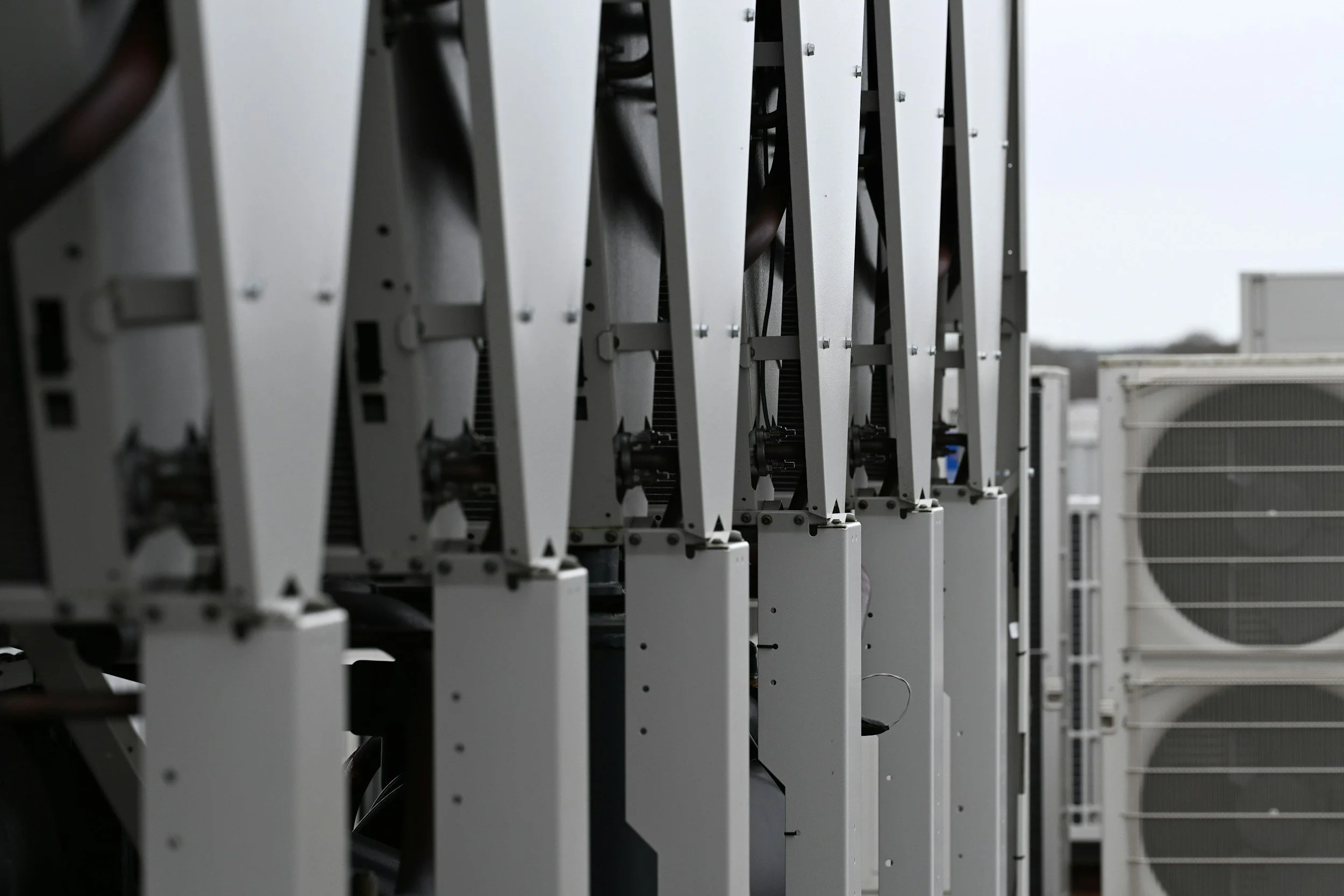
 Cooling Equipment Side by Side:
Heat Pump- A dual-role solution

We have discussed about heat pump is the first HVAC fundamental article as the major mechanism of heat exchanger. When repeat the importance of heat pump here, we focus more on the combination of compression refrigeration cycle and the condensing equipment. This combination is not limited to only heating or cooling the space, it also can be configured in air-air, air-water and water-water arrangement, providing substantial flexibility for building designers.

Final Takeaway

Mechanical selection is always a trade off between first cost, space and efficiency. Heating distribution design is greatly varied by heating medium (air or water), while cooling performance is driven by how the heat is rejected from a space. Air-cooled systems offer low upfront cost, a smaller footprint and simpler installation, whereas water-cooled systems require higher initial capital and complex infrastructure to deliver a long-term indoor comfort and energy efficiency for large-scale buildings.
Ohm’s Law & Beyond: The Fundamental of Electricity by Admin

Much like human comfort, electrical engineering comes with its own unique language. At its core, electricity flows much like water in a hydraulic system, governed by three fundamental factors: potential/force, current, and resistance. Electrical force (V) is measured in volts, current (I) in Amps, and resistance (R) in Ohms.

Below are the questions I prepared myself before speaking with electrical engineers.

How is electricity transmitted and powered?

Direct Current (DC) means current flows in one direction at a constant voltage.

Alternating Current (AC) is based on the concept that electricity has nearly no inertia, and the direction of the flow can be reversed rapidly by reversing voltage.  AC voltage can easily be stepped up to very high voltage for long-distance transmission (reducing line losses as V=IxR and P= IxV ) and stepped down safely within the building.

How is electricity used?

Generator: it is a device that converts mechanical energy into electrical energy.

Transformer: it is a device that uses different numbers of coils to step up or step down the voltage.

Wiring: The sizes of electrical wiring are standardized using American Wire Gage (AWG); the number goes from #14 up to #4/0(0000). #14 is considered the smallest allowed for standard residential branch circuits, and 0000 is the largest. (wires larger than #4/0 switch to kcmil(MCM) sizing.)

Voltage Setting:

  • Residential buildings usually receive 120/240V single-phase.

  • Small to medium commercial buildings usually receive 120/208V three-phase

  • Large commercial buildings require higher voltage, such as 277/480V three-phase.

Capacitor: it is a set of two plates separated by a small insulating layer. Currently, it is stored on one plate

Receptacle: it is also known as an outlet or wall plug, used to connect appliances to the circuit.

Electric feeder: it is a device that carries power from the main service to the subpanel

How to use different loads to design electrical equipment?

  • Resistive Load: such as toaster oven, incandescent light bulb. Increasing the cross-sectional area is a way to reduce resistance. Larger conductor directly mitigates voltage drop across long distances

  • Inductive Load: refrigerator, air conditioner, washing machine are this type of load.

  • Capacitive Load: devices such as capacitor banks to stabilize the power system

How to make sure we use electricity safely?

  • GFCI-Detects small current imbalance (4amp to 6 amp) between hot and neutral wire to prevent human electrocution

  • AFCI- it detects unintended electrical arcing conditions in circuit wiring to prevent electrical fire. (Electrical arcing is the luminous, high-temperature discharge of electric current that jumps across an insulating gap, such as air, between two conductors)

  • Load Control: Itl is normally installed directly next to the main electrical circuit breaker panel or inside a dedicated electrical utility room. They are integrated into this locations such as main electrical panel, utility room, junction box.

Safety Measurement by Code

  • 10-Second Rule

2024 IBC 2702.1.4 Load Transfer: Emergency power system shall automatically provide secondary power within 10 seconds after losing primary power. Standby power shall provide secondary power within 60 second after losing primary power. (This 10-sec rule is derived from NEC 700.12. NEC article 700 governs the design, installation, operation, and maintenance of legally required emergency systems.)

  • 90-Minutes illumination

2024 IBC 1008.3.1 Means of Egress Illuminsation talks about the required duration for emergency power system shall be minimum 90 minutes, and shall consist of storage batteries, unit equipment or an on-site generator.

2024 IBC 2702.2.14 Means of Egress Illuminsation: Emergency power shall be capable of powering the required load for duration not less than 90 minutes.

  • 2 hours Emergency and Standby Power

2024 IBC 2702.1.5 Load Duration: Emergency power system and standby power system shall be designed to provide the required power for minimum duration of 2 hours without being refueled and recharged.

  • Workspace Requirement

2024 IBC 1010.2.8.2. Door Gate and Turnstiles: Rooms containing electrical equipment rated 800 ampere or more shall NOT be provided with a latch or lock other than panic hardware or fire exit hardware.

2024 IRC 3405.1 Workspace and Clearance: fig. 3405.1. states a 30-inch by 36-inch working space is required in front of energized equipment and panel board.

HVAC Fundamentals by Admin

Heat Pump and Vapor-Compression Refrigeration Cycle

A heat pump is a mechanical device that uses a refrigerant cycle to transfer heat energy between inside and outside of a building to condition the space.

The refrigeration cycle is a standard thermodynamic cycle that uses these four components to achieve refrigerant phase change.

Expansion Valve: An expansion valve is a control device that meters and regulates refrigerant flow to the evaporator coil, reducing high-pressure liquid to low-pressure liquid.

Evaporator (coil): An evaporator coil allows cold, low-pressure refrigerant to enter and absorb heat from the surrounding air, reducing the temperature of the space. As the cold liquid refrigerant absorbs heat from the warm air, it boils and evaporates into a low-pressure gas before moving on to the compressor.

Compressor: A compressor is a mechanical component that draws in low-pressure refrigerant gas from the evaporator, squeezing it into hot, high-pressure gas.

Condenser (Coil): It receives the hot, high-pressure gas from the compressor and releases its heat to the outside air, condensing the refrigerant back into a high-pressure liquid.

Types of Distribution systems

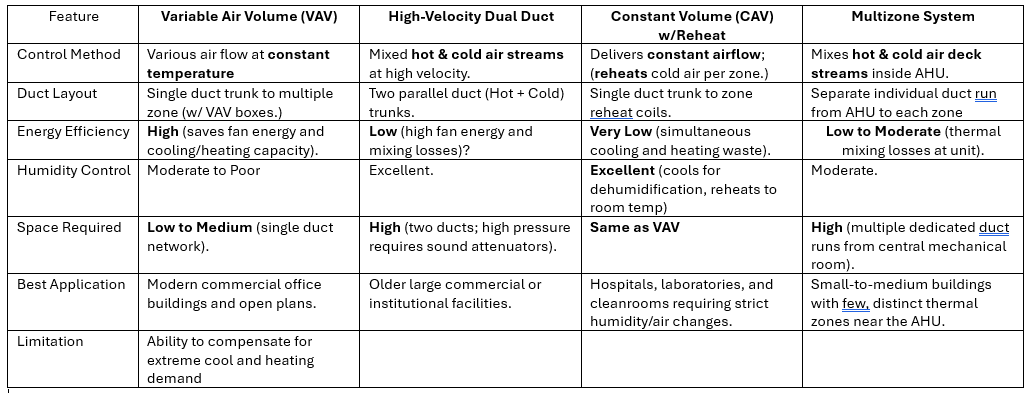
All-Air Systems (Air handles both thermal load AND fresh ventilation)

  • Variable air volume (VAV): the system blows air from a central air handler and uses the terminal box with motorized dampers in each room to control the temperature. It is efficient due to its single duct layout.  

  • High -velocity dual duct: This system uses a central air handler and two parallel main supply ducts to supply air throughout the building. At each zone, a terminal mixing box blends the hot and cold air streams in a specific ratio to achieve the exact room thermostat temperature.

  • Constant air volume (CAV) reheat: the system blows out constant cold air from the central fan room and reheats at the end of the terminal of each room to control the temperature. This is the least energy-efficient system, but provides good humidity control and doesn't require much duct space.

  • Multizone system: The system separates supply ducts to run directly from a central AHU to every individual zone. High duct friction and space requirements near the mechanical room.

All-water system (Water handles thermal loads; NO fresh ventilation built-in)

  • The system uses insulated piping to distribute heated or chilled water from a central plant to hydronic terminal units located directly within the conditioned space. And because water pipes only use water to transfer thermal energy, they are not responsible for bringing fresh outdoor air into the space.

Air-Water system (Water handles thermal loads; air handles ventilation)

  • One of the air-water combination systems is the air-water induction system. The system uses nozzles to draw air inside each terminal unit at the building perimeter, and air passes through coils that contain cool or hot water to cool or warm the space.

  • The main difference between the all-air system and the air-water induction system is that the air-water terminal unit has no fan or other local moving parts. Unlike the all-air system, the air-water system requires small ductwork, thus becoming a space -saving solution that provides higher floor-ceiling clearance.


Psychrometrics & Beyond: The Language of Thermal Comfort by Admin

What is a Psychrometric chart?

A psychrometric chart is a graphic representation of thermodynamic properties. The chart is used in building design and HVAC engineering to plot air conditions, calculate heating/cooling loads, and track HVAC processes.

Dry-Bulb Temperature

  • Ambient air temperature measured by a standard thermometer unaffected by humidity or direct thermal radiation

Wet-Bulb temperature

  • Temperature measured by a thermometer in a water-soaked wick with air passing over. It reflects total heat content and evaporative cooling capacity.

Relative Humidity(RH) vs. Specific Humidity (SH)

  • RH: It measures how close the air is to being saturated with water vapor at a given temperature.

  • SH: It measures the mass of water vapor per unit mass of air, expressed in units such as "g/kg". It is independent of temperature and air volume; that means as long as no water vapor is added or removed, the specific humidity remains constant regardless of whether the air temperature goes up or down.

Saturation Line

  • The 100% relative humidity boundary curve on a psychrometric chart where dry-bulb and wet-bulb temperature are identical

Dew point temperature

100% saturated with water vapor and moisture begins to condense into liquid.

Mean Radiant Temperature (MRT)

  • Weighted average surface temperature of all surrounding materials facing an occupant. It governs radiant heat exchange.

Operative temperature

  • Operative temperature is a weighted average temperature that combines air temperature and mean radiant temperature to represent the overall thermal comfort experienced by an occupant.

For example, you are sitting next to a large floor-to-ceiling double-glazed window. The thermostat on the wall reads a cozy 72°F. Because it's freezing outside, the inner glass surface temperature has dropped, and your surrounding Mean Radiant Temperature (MRT) drops to around 56°F in that perimeter zone. Below is how to calculate how you feel in that environment.

  • Operative Tem=[72°F (Drybulb)+ 56°F (MRT)]/2 =64°F


PS. The equation listed above is a simplified version. It isn't always a simple 50/50 split. It is a weighted average, where the weighting depends on air velocity. At low air speed (less than 40 fpm), convective and radiant heat transfer are roughly equal, so it simplifies to the average of 2. At higher air speed, convective heat transfer dominates, so the air temperature gets a higher weighting in the formula.


Sensible Heat

  • Thermal energy that changes dry-bulb air temperature without changing the moisture content of the air.

Latent Heat

  • Thermal energy absorbed or released during a phase change, without altering dry-bulb temperature.

Sensible Heat Ratio (SHR)

  • Ratio of sensible heat load to total heat load (=sensible heat+latent heat)in a conditioned space. In other words, it is simply the percentage of that total cooling load that goes toward dropping the air temperature (sensible heat) versus removing humidity (latent heat)

SHR= Sensible Capacity/ Total Capacity

High SHR (over 0.85+) means the cooling load is almost entirely temperature-driven

Reading the Psychrometric Chart…

Basics:

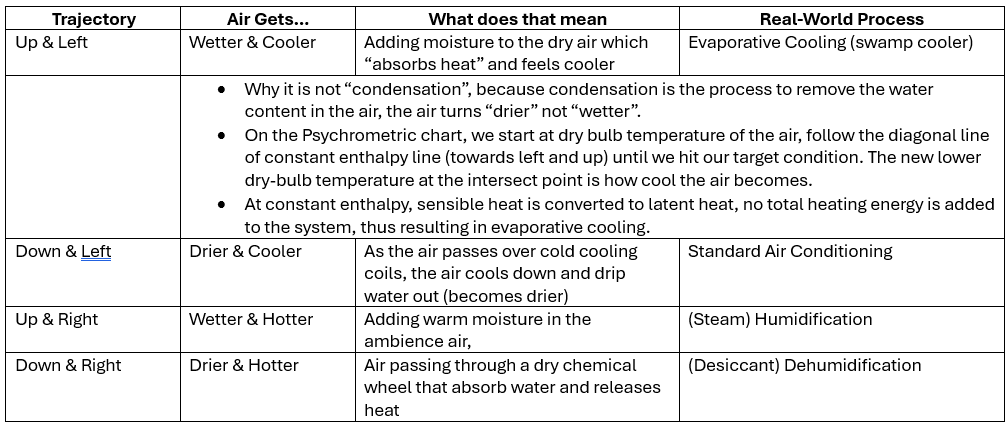
  • Move Trajectory Horizontally Left on Psychrometric Chart: Sensible cooling process at a constant specific humidity ratio.

  • Move Trajectory Horizontally Right on Psychrometric Chart: Sensible heating process at a constant specific humidity ratio.

How does Psychrometric chart explain our Comfort Zone?

  1. Setting baseline: We start at our comfortable baseline, say 75 °F DBT at 50% RH.

  2. Altering moisture contemt: In the chart, we can think of adding the moisture content (move up along SH line) to the same dry-bulb temperature line.

  3. Tracing back along same comfortable curve: Then trace the RH curve/same-comfort line back to the left.

  4. Looking for intersection: To keep the same level of skin comfort, we need to shift the dry-bulb temperature to the left intersect point (cooler temperature) as humidity rises.

What’s the Impact of High Indoor Relative Humidity?

When indoor relative humidity (RH) rises above the recommended range (about 40%~60%), it triggers a cascade of issues affecting human comfort, occupant health, building systems, and structural durability. For example

  • Human Comfort: Inhibited Evaporative Cooling

The human body cools itself primarily through the evaporation of sweat from the skin. When surrounding air is saturated with moisture, sweat cannot evaporate efficiently into the air.

  • Indoor Air Quality: Biological Contaminant Growth

Mid-range humidity minimizes airborne pathogen viability. High humidity creates a prime breeding ground for biological agents. For example, mold and mildew grow on organic surfaces when elevated humidity persists for more than 24-48 hours.

PS. Refer to EPA's course: Why and Where Mold Grows.

  • Building Envelope Durability: Surface Condensation

When air with high RH meets a colder interior surface, it cools to the dew point temperature and condenses directly onto that surface. That phenomenon leads to material degradation, such as drywall softening and sag, paint peeling, or metal joints corroding over time. When the condensation occurs within wall cavities, it damages insulation performance and creates hidden mold hazards that are difficult to remediate.

  • HVAC energy: Latent Cooling Overload

To lower humidity, active cooling coils must drop air temperature below the dew point to condense out moisture. The process demands significant latent energy capacity.

How to find a Dew Point in a Psychrometric Chart?

For example, finding a Dew Point for Air at 75°F at 70% RH

  1. look for the 75°F temperature line at the bottom scale (dry bulb).

  2. follow its vertical line and move up to meet the 70% RH curve.

  3. draw an imaginary horizontal line towards the left to the edge (where the 100% RH curve is).

  4. Read the degree on the wet-bulb/dew point temperature, and you will get 64°F as the approximate Dew Point.


By the way…
If you like this article, you might also like
How to Beautify Home & Boost Your Immune System.

Decoding IBC for Placemakers-I by Admin

Building code is a set of legal rules and minimum standards for how structures are designed, built, and maintained. Local governments enforce these rules to protect the general public's health, safety, and general welfare.

For many industry professionals, checking the code is a fundamental step before their pens even touch paper. There are several critical chapters in the building code that it would be good for property owners to understand before reaching out to contractors.

Codes that Shape Building Size

I- Chapter 3 Occupancy Classification and Use

The intended use of a space forms the basis of all building code evaluations. While zoning ordinances classify land use based on economic and master-planning goals, the building code classifies occupancy groups based on its use, structural safety, occupant safety, and involved hazard levels.

The International Building Code (IBC) establishes ten primary occupancy groups:

  • Assembly (A)

  • Business (B)

  • Education (E)

  • Factory and Industrial (F)

  • High Hazard (H)

  • Institutional (I)

  • Mercantile (M)

  • Residential (R)

  • Storage (S)

  • Utility and Miscellaneous (U)

Knowing the occupancy classification is important because that information will not only determine the size of the building, but almost every downstream technical requirement: from allowable floor area, maximum height, occupant load calculation, egress paths, interior finishings, fire protection system, and plumbing fixtures.

Everything seems pretty straightforward for a single-use building. However, the questions, further interpretations, and additional coordination often come when a project has various programs with multiple uses.  Early understanding and coming up with a code-compliant design solution reduce unnecessary rework or unpredictable cost later on.

II-Chapter 5 General Building Height and Area

Once the building's use is determined, the building code takes us to the next more tangible level: building size, height, and area. From an economic perspective, developers often aim to maximize floor space using the most cost-effective construction type permitted by code.

The most common criteria and limitations are organized in the following tables:

  • Table 504.3 Allowable Building Height (above Grade Plane)

  • Table 504.4 Allowable Number of Stories (above Grade Plane)

  • Table 506.2 Allowable Area Factor

When running into a project that has multiple occupancies, specific metrics determine whether occupancies can be mixed or separate in a floor plate or in a building structure. The terms listed below are common metrics to use during the determination process.

  • Accessory occupancies (508.2):

An accessory occupancy is a space or a room that is supplementary to a main occupancy, but that does not exceed 10% of the floor area of its located story. An accessory occupancy does not need to be separate from the main occupancy with a fire barrier. A common example would be a retail space in an apartment building.

  • Incidental Uses (509):

On the other hand, the incidental use is secondary to a main occupancy and has the same classification as the nearest main occupancy, but poses a greater level of risk than that occupancy. Unlike accessory use, the incidental use must be separate from the main occupancy by a fire barrier, which we will see more details on how it should be constructed in Chapter 7.

  • Horizontal Separation (510.2)

This tool is applied to a project because it allows two different building types or heights to sit atop a podium. With this 3-hour horizontal assembly, a project can often accommodate mixed-use in the same lot, save construction costs by using combustible material atop a noncombustible podium, and maximize density and height per square foot.

III-Chapter 6 Type of Construction: The Five Construction Type

Chapter 6 has also been a fundamental part of the model codes since their inception (in the early 1900s). The code ranks construction types from Type I (most fire-resistant) to Type V (least fire-resistant).

  • Type I & II: require structural elements to be made entirely of noncombustible materials like steel, concrete, or masonry.

  • Type III, IV, & V: Allow the use of combustible material for structural framing, subject to strict fire-rating standards.

  • Each type is further divided into Subtype A (Protected) and Subtype B (Unprotected), where "protected" means structural elements are coated or wrapped to achieve higher fire-resistance ratings for at least 1 or 2 hours.

Building codes create a direct balance between material type and allowable size. For example, if we employ Type IA (noncombustible), there is no limit on height or floor area because the building itself resists structural failure during a fire. On the other hand, if the project uses Type VB(combustible), the allowable height and area are capped to ensure occupants can safely evacuate before the building core support parts are weakened, damaged or broken.

Most critical information is consolidated in Table 601, "Fire-resistance rating requirements for building elements", and its briefer descriptions are outlined in 602.


A Side note:

  • With advancing technology and market trends, Type IV-C and correlated mass/heavy timber (HT) construction were officially approved in January 2019 and finally became an official standard with the 2021 IBC edition.

  • Fire Resistance: it means the property of materials or their assemblies that prevents or retards the passage of excessive heat, hot gases, or flames under conditions of use.

  • Fire Safety Function: Building and fire control functions that are intended to increase the level of fire safety or to control the spread of harmful fire.

  • Non-Combustible: They are materials that no part will ignite or burn when subjected to fire. Consequently, IBC did not have a definition of what "combustible materials" are. Only Combustible Dust, Combustible Fiber, and Combustible Liquid.

The Effect of Zoning on Our Lives by Admin

What are zoning regulations?

Zoning regulations are a set of multiple rules that control how land can be used and developed, specifying permitted activities, building use, and development standards. These rules shape the relationship between the land and the building. Here is the breakdown of its core concept and zoning metrics.

I.Land Use & Permitted Uses

Private lands are primarily classified into the following districts: Residential(R), Commercial(C), Industrial(I), Agricultural(A), and Mixed-Use (MU).

Within these districts, land-use activities are further categorized into four distinct operational tiers—"Permitted Uses", "Limited Use", "Conditional Uses", and "Uses not Allowed"—that dictate what activities happen on our lands and how we live, work, or play in our neighborhoods.

  • Permitted Uses: They are allowed by right. The owner can operate such use on their land without asking additional permission.

  • Limited Use: They are allowed under certain circumstances. The property owner can operate such use on their land as long as they follow the sub-categorized rules.

  • Conditional Use: They are allowed after review and approval by a zoning board subject to specific operational conditions.

  • Use Not Allowed: They are the uses prohibited in their designated district.

II.Building bulk& Density Control

This is the heart and core of the zoning regulation, and the main focus that urban designers focus on. The idea behind these regulations were to ensure adequate daylight, ventilation, privacy, off-street parking and essential site logistics are properly contained within the property boundaries. Below are some common zoning metrics that shape the look and feel of our built environment.

  • Lot Coverage: The percentage of lot area occupied by the building footprint.

  • Density Limit: It dictates the maximum allowable dwelling units per acre for residential development.

  • FAR: It is the ratio os the gross floor area within a structure to the area of the lot on which the structure is situated.

  • Setback: It means the minimum distance a building must be placed from a property line. Front setback is usually the greatest setback distance. The rear setback is the distance from the back of the lot. The side setback is the distance from the side property line.

  • Bulk Plane Restriction: It is a zoning technique that establishes an imaginary inclined plane, and the building volume cannot extend beyond that plane.

III.Relief & Compliance Mechanism

There are mechanisms and tools that property owners can use before they develop a land or when they are facing challenges with imposing updated regulations on their existing structures. Here are the critical terms property owners need to know.

  • Non-Conforming Use: It means existing uses or structures that were legal prior to zoning code changes but do not comply with the current regulations.

  • Variance: It is the official permission to deviate from some provision of the zoning code due to the hardship on a specific site.

  • Planned Unit Development (PUD): It is a flexible zoning framework that allows mixed uses, customized development standards, and higher density in exchange for public amenities or open spaces.

Final Takeaway, Why They Matters?

We can’t comfortably play a game if we don't know the rulebook. Whether dealing with local zoning ordinances, community policies, or property rights, taking the time to digest the fundamental framework of zoning code transforms a set of complex texts into a practical toolkit—giving you the real agency and confidence to self-advocate whenever needed.

Decoding Sustainable Design Principles & Standards by Admin

Sustainable Design from ARE exam isn’t just about “being green”— it’s about understanding how life cycle assessments, rating systems and enforceable code integrate into a real-world building design process. Here is the breakdown from its concept to industry standards.

What is sustainability?

It is the ability to meet the needs of the present generation without compromising those of future generations.

What is sustainable design practice?

Sustainable design practice focuses on reducing environmental impact, conserving resources, and enhancing human well-being throughout the lifecycle of a product, system, or service.

Why does sustainable design practice matter?

It matters because it represents a mentality shift from short-term, purely functional design to a holistic approach that considers long-term impacts on the planet and society. Through its holistic approach, it will ensure long-term environmental, social, and economic benefits.

What are the strategies to reach a project's sustainability goal?

Common strategies for existing buildings are through recycling, reuse, and also mitigating hazardous materials.

  • Adaptive Reuse: It is to repurpose existing buildings for new uses. Though it might not always be the most cost-saving solution, it is often the greenest option because it reduces resource consumption, cutting emissions and delivering resilient solutions.

  • Recycling Materials: It is the capacity of a previously used material as a resource in the manufacture of a new product. It directly meets sustainability targets because it aligns with the circular economy and the waste hierarchy, which prioritize reuse and recycling over landfilling.

  • Hazardous Material Mitigation: It is a proactive way to reduce the use of harmful substances that pose risks to human health and the environment; thus, it directly meets the purpose of sustainability by reducing environmental impacts.

Common strategies for new constructions are using energy-efficient design principles, such as conducting Life Cycle Cost Analysis or planning for certifications during the early phase of a project, which you will dive more in-depth into in the following paragraph.

What does energy efficiency mean?

Energy efficiency is the reduction of the energy that must be consumed to provide various services and functions, particularly compared to sustainable standard baselines.

How do we evaluate energy efficiency?

There are several methods, tools, or certifications that we use for evaluating the environmental impact. Here are some common examples:

  • Life Cycle Assessment (LCA): It is a systematic method for measuring the total environmental impact of a product across its entire life. There are four stages covered in the assessment, from raw material acquisition, manufacturing, use and maintenance, to the product's disposal.

  • Whole Building Life Cycle Assessments (WBLCA): It is a systematic method for analyzing all inputs, outputs, and potential environmental impacts of a building over its entire life span. Unlike product-level LCA, which focuses on individual materials or components, WBLCA considers the entire building as a system, providing a holistic view of embodied carbon, resource use, and environmental impacts.

  • Environmental Product Declarations (EPD): It is a verified standardized document that communicates the life cycle environmental impacts of a product. This tool is developed by manufacturers who follow ISO 14025 standards to provide objective, third-party verified information about their products.

EPDs can be used along with other product certification systems, such as GREENGUARD for flooring, Forest Stewardship Council (FSC) for wood products, GREENSEAL for doors and windows, etc.

  • LEED: It stands for Leadership in Energy & Environmental Design. It is a green building rating system that is designed to provide an actionable framework for designing, constructing, operating, and maintaining energy-efficient and sustainable green buildings. Its credits surround these areas: Decarbonization (50%), Quality of Life (25%), and Ecological conservation and restoration(25%). There are four certification levels to be achieved within LEED: Certified(40-49), Silver(50-59), Gold(60-79), and Platinum (80+)

  • Green Globes: It is also a green building rating system. Unlike LEED, Green Globes are especially applied to commercial real estate. Buildings are scored out of 1000 points. Unlike most LEED credits, which have prerequisites, projects submitted to Green Globes are allowed to remove points altogether to prevent projects from being unfairly penalized for environmental criteria that are physically impossible to meet. When points are removed, a project's target threshold shifts to a customized scale. The evaluated building must achieve at least 35% of the adjusted points pool to earn the certification.

What are the regulations and industry standards related to sustainability?

There are many standards related to sustainability. I just highlight a few of the most well-known and popularly adopted, such as:

ASHRAE 90.1- Energy Standard for Buildings Except Low-Rise Residential Buildings. It is a widely recognized energy efficiency standard that sets minimum requirements for the design and operation of commercial buildings. It outlines building envelope requirements, zone isolation, insulation for floors/ceilings/roofs, and power allowance calculations.

ASHRAE 189.1- Standard for the Design of High-Performance Green Buildings Except Low-Rise Residential Buildings. It establishes mandatory, prescriptive, and performance-based requirements. Unlike LEED guidelines, ASHRAE 189.1 is code-enforceable, making it suitable for adoption by local, state, and national jurisdictions.

ASHRAE 700- National Green Building Standards. It provides sustainable standards for residential buildings. It uses IECC as a basis and applies to residential buildings.

ASHRAE 62.1- Ventilation and Acceptable Indoor Air Quality. It establishes...

  • minimum ventilation rates for a wide range of occupancy types. requirements for HVAC system design, outdoor air quality assessment, infiltration and air distribution.

  • operational and maintenance practices to maintain acceptable IAQ.

  • limits on contaminants and guidance on moisture and biological growth controls.

ASHRAE 62.2- Ventilation for Acceptable Indoor Air Quality in Residential Buildings. This standard established the following standards:

  • minimum demand-controlled ventilation rate based on floor area and occupancy number.

  • local mechanical exhaust system for kitchen and bathroom

  • filtration requirement for air-cleaning devices

  • moisture control

  • Optimal IAQ procedure.

ASHRAE 55- Thermal Environmental Conditions for Human Occupancy. It establishes ranges of indoor environmental conditions to achieve acceptable thermal comfort for occupants. It is directly linked to sustainable design practice because it provides the scientific basis for creating a comfortable, healthy indoor environment that can be achieved with efficient systems.

IECC- The International Energy Conservation Code. It is a model code developed by the International Code Council to regulate minimum energy conservation requirements for new buildings.

IgCC- It stands for the International Green Construction Code. It is a comprehensive green building code developed by ICC in collaboration with other industry organizations. Unlike LEED, the IgCC establishes mandatory. enforceable requirements that jurisdictions can adopt to ensure buildings meet minimum sustainability standards.

The IECC focuses strictly on energy efficiency and savings for buildings. In contrast, the IgCC is a broad, whole-system green building code that covers energy alongside site sustainability, water use, indoor air quality, and materials.


By the way…

If you like this technical notes, you might also like: What You Need To Know Before Designing Green Roof

Design With A Passive System by Admin

What is passive design?

A passive building system uses the local climate, sun, and wind to heat, cool, or light the space naturally without relying on mechanical equipment.

Why does passive design strategy matter?

Passive building design strategy matters because it maximizes energy efficiency and indoor comfort with specialized materials.

It might have a higher initial cost due to specific materials and construction methods; it also requires more precise craftsmanship and early planning. However, once the material is selected and planning is thoroughly thought through during the early schematic design and site analysis phase, the project is likely to have a predictable outcome and is unlikely to change its look or feel later on regardless product market-price fluctuations or budget constraints.

What are the passive design strategies?

Passive heating:

Passive heating can lower utility bills, eliminate greenhouse gas emissions, and increase indoor comfort with steady room temperature. On the other hand, sometimes they require expensive custom construction and are difficult to retrofit into existing homes. Common architectural passive heating elements are:

  • Attached Sunspace Heating: it uses a glazed, room-like addition built on the equator-facing side of the building to capture sunlight and heat. Then gradually releases heat indoors.

  • Trombe Wall: it lets sunlight pass through the glass, warms the dark surface, and stores warm air as heat penetrates through it.

  • Flat Collectors: it is also known as a "flat plate solar collector". It is a specialized heat exchanger that converts sunlight into thermal and heat energy.

There are also simi-passive/semi-active system:

  • Fan-forced Rockbed Solar Heating: it uses passive solar design to capture heat through glazing, and uses active mechanical parts like the fan and blower to push warm air from bedrocks into the room.

Passive cooling:

Passive cooling uses heat avoidance, thermal mass storage, heat dissipation, and natural ventilation to cool a space. Instead of focusing heavily on building materials, passive cooling is more strategically focused on orienting and laying out the building based on its local climate to reach a desirable cooling outcome.

For example, in a mixed humid climate, a building should be placed on an east-west axis, with a compact form and central courtyard. If it is located in a hot humid climate, the building should have fenestration on both the leeward and windward sides of elevations to increase its cross ventilation. It would also be helpful for a building to have an elevated foundation and a high ceiling.

Common architectural passive cooling elements are:

  • Cross ventilation: it is a natural cooling method where wind enters through an opening on one side of the building and moves across the interior space and then exits through an opening on the opposite side.

  • Stack ventilation: it cools the building by using warm air rising. It relies on low-level vents pulling in cool outdoor air and letting hot air escape from the top.

  • Evaporative cooling: it lowers the temperature by utilizing the heat-absorbing power of evaporating water. The evaporative cooling method is especially ideal in a hot and arid climate when the humidity level is under 40%. The designer uses a wind tower/catcher, a water feature in the courtyard, or a wetted hanging fabric to maximize water evaporation in a space in order to achieve its highest possible temperature drop.

  • Thermal mass cooling: it is a design technique where dense building material absorbs and stores unwanted indoor heat during the day. The heat is flushed out at night due to cool air ventilation, thus making the structure stay cool.

Final Takeaway…

Great spatial design isn't just about layout and aesthetics; it is more about how a space interacts with its environment. Whether you live in a cold climate or a hot & humid climate, there is always a passive strategy for your home to give steady and predictable comfort that you desire.