
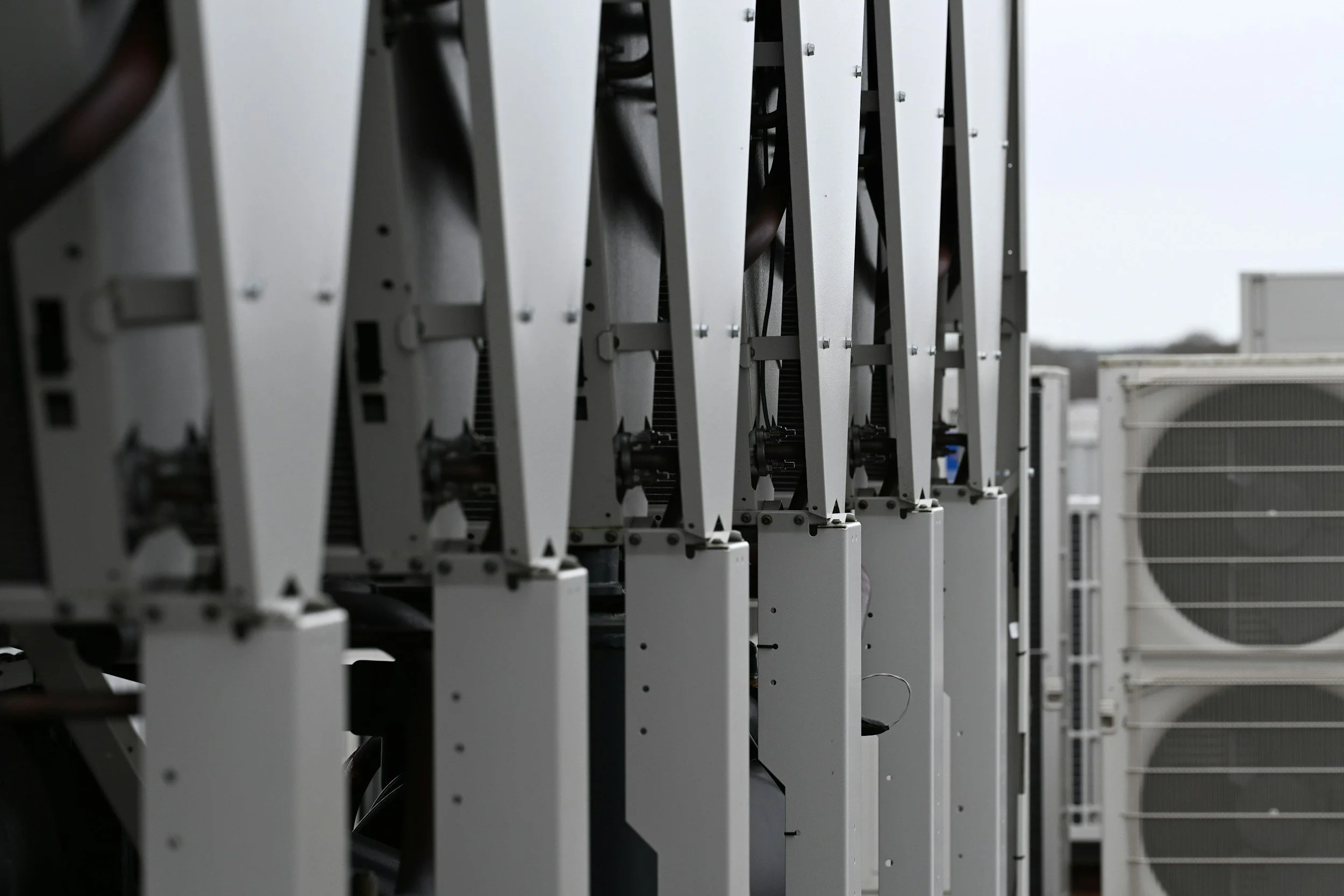
Heat Pump and Vapor-Compression Refrigeration Cycle
A heat pump is a mechanical device that uses a refrigerant cycle to transfer heat energy between inside and outside of a building to condition the space.
The refrigeration cycle is a standard thermodynamic cycle that uses these four components to achieve refrigerant phase change.
Expansion Valve: An expansion valve is a control device that meters and regulates refrigerant flow to the evaporator coil, reducing high-pressure liquid to low-pressure liquid.
Evaporator (coil): An evaporator coil allows cold, low-pressure refrigerant to enter and absorb heat from the surrounding air, reducing the temperature of the space. As the cold liquid refrigerant absorbs heat from the warm air, it boils and evaporates into a low-pressure gas before moving on to the compressor.
Compressor: A compressor is a mechanical component that draws in low-pressure refrigerant gas from the evaporator, squeezing it into hot, high-pressure gas.
Condenser (Coil): It receives the hot, high-pressure gas from the compressor and releases its heat to the outside air, condensing the refrigerant back into a high-pressure liquid.
Types of Distribution systems
All-Air Systems (Air handles both thermal load AND fresh ventilation)
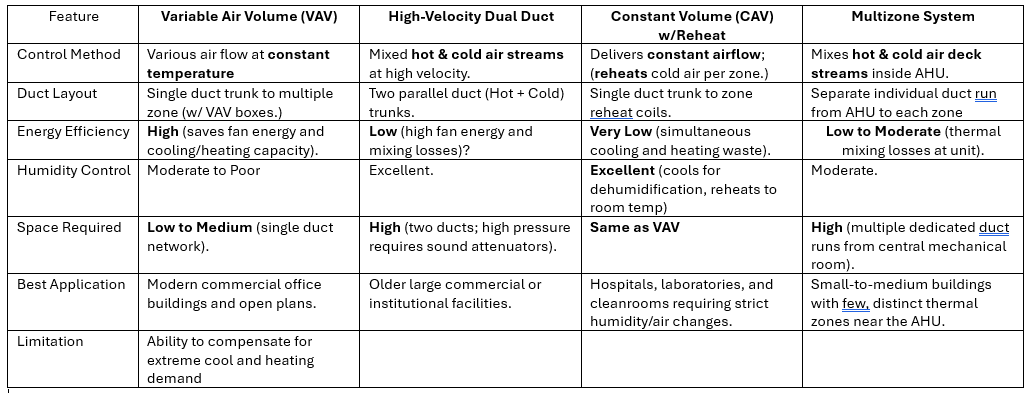
Variable air volume (VAV): the system blows air from a central air handler and uses the terminal box with motorized dampers in each room to control the temperature. It is efficient due to its single duct layout.
High -velocity dual duct: This system uses a central air handler and two parallel main supply ducts to supply air throughout the building. At each zone, a terminal mixing box blends the hot and cold air streams in a specific ratio to achieve the exact room thermostat temperature.
Constant air volume (CAV) reheat: the system blows out constant cold air from the central fan room and reheats at the end of the terminal of each room to control the temperature. This is the least energy-efficient system, but provides good humidity control and doesn't require much duct space.
Multizone system: The system separates supply ducts to run directly from a central AHU to every individual zone. High duct friction and space requirements near the mechanical room.
All-water system (Water handles thermal loads; NO fresh ventilation built-in)
The system uses insulated piping to distribute heated or chilled water from a central plant to hydronic terminal units located directly within the conditioned space. And because water pipes only use water to transfer thermal energy, they are not responsible for bringing fresh outdoor air into the space.
Air-Water system (Water handles thermal loads; air handles ventilation)
One of the air-water combination systems is the air-water induction system. The system uses nozzles to draw air inside each terminal unit at the building perimeter, and air passes through coils that contain cool or hot water to cool or warm the space.
The main difference between the all-air system and the air-water induction system is that the air-water terminal unit has no fan or other local moving parts. Unlike the all-air system, the air-water system requires small ductwork, thus becoming a space -saving solution that provides higher floor-ceiling clearance.