
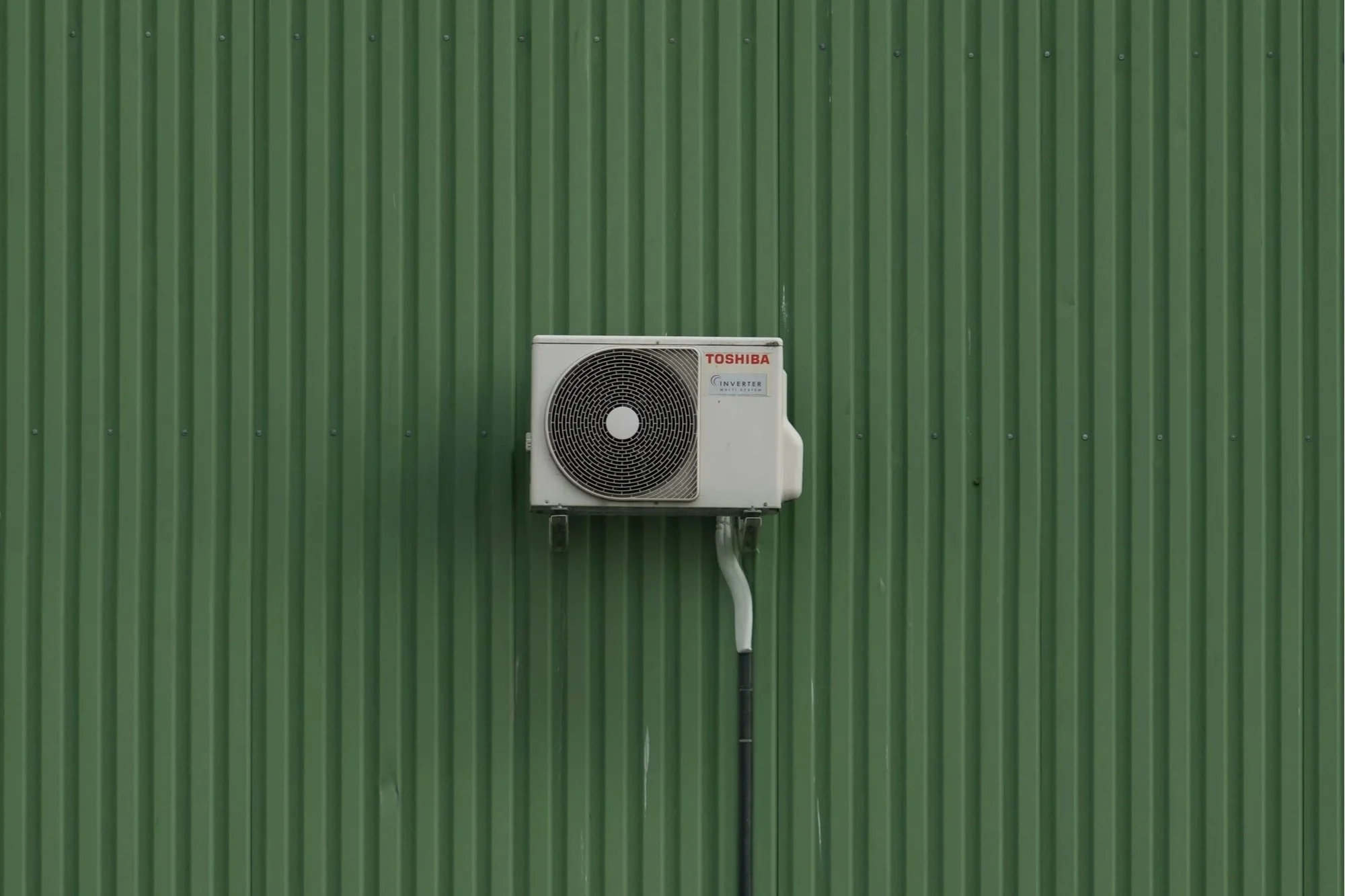
What is Active Climate Design?
As the name implies, active climate control systems operate on the opposite principle of passive climate design. Instead of relying solely on building orientation, thermal mass, or natural ventilation, active systems consume power to directly modify thermal comfort and indoor air quality (IAQ).
Key Characteristics of Active Systems
Active systems generally share four core traits:
Purchased Energy Dependency: They require external energy inputs (electricity, natural gas, fuel oil, or propane) to operate.
Dedicated Mechanical Components: They rely on single-purpose mechanical equipment such as pumps, fans, compressors, and burners.
Envelope Integration: Highly effective active design is well-thought-out and tightly integrated with the building envelope rather than added as an afterthought.
Specialized Engineering: They are typically engineered by specialized MEP (mechanical, electrical, plumbing) consultants rather than solely designed by the architect or builder
Primary Heating Equipment
The acronym HVAC (Heating, Ventilation, and Air Conditioning) encompasses these mechanical strategies. Below are the primary heat sources and distribution mechanisms driving active climate control.
Furnace: it is a closed unit that uses combustion or electric resistance to heat air. In a residential setting, the equipment burns gas, propane, fuel oil or uses electric resistance to generate the heat source
Boiler: it is a closed metal vessel that heats water or generates steam to serve as the hydronic heating medium.

Unlike heat pumps—whose efficiency and output drop as outdoor air temperatures plummet—furnaces and boilers deliver consistent heat output regardless of the outdoor temperature. Because they generate heat directly through combustion (or electrical resistance) rather than relying on refrigeration cycle, they have no minimum operating temperature cutoffs limits when performing their jobs. ( Occasionally, furnaces or boilers might experience frozen pipes or vent icing during extreme weather, which can disrupt smooth operation.)
Major Cooling Mechanism
The fundamental challenge of active cooling is pumping heat out of cooler indoor space and rejecting it into warmer outdoor environment. The HVAC industry relies on several primary mechanisms and equipment configurations to achieve this.
Vapor Compression Refrigeration Cycle: The core thermodynamic process driving mechanical cooling. In central plant systems, it acts as a thermal bridge between a chilled water loop (which absorbs indoor heat) and a condenser water loop (which rejects heat outdoors).
Direct Expansion (DX) vs. Variable Refrigerant Flow (VRF):
Direct Expansion (DX): Delivers cooling directly as indoor air passes across an evaporator coil containing circulating refrigerant. Their evaporate coil can be located only 100 ft or so from the compressor or system.
Variable Refrigerant Flow (VRF): A flexible DX system where one outdoor compressor/condenser unit feeds multiple individually controlled indoor evaporators. This arrangement is similar to that found in ductless mini-split systems, where single outdoor unit can be used with several evaporator units.
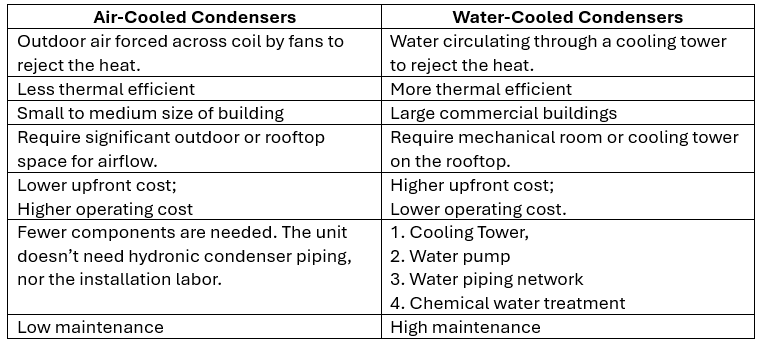
Cooling Equipment Side by Side:
Heat Pump- A dual-role solution
We have discussed about heat pump is the first HVAC fundamental article as the major mechanism of heat exchanger. When repeat the importance of heat pump here, we focus more on the combination of compression refrigeration cycle and the condensing equipment. This combination is not limited to only heating or cooling the space, it also can be configured in air-air, air-water and water-water arrangement, providing substantial flexibility for building designers.
Final Takeaway
Mechanical selection is always a trade off between first cost, space and efficiency. Heating distribution design is greatly varied by heating medium (air or water), while cooling performance is driven by how the heat is rejected from a space. Air-cooled systems offer low upfront cost, a smaller footprint and simpler installation, whereas water-cooled systems require higher initial capital and complex infrastructure to deliver a long-term indoor comfort and energy efficiency for large-scale buildings.