
What shines Helena’s Beauty Empire?
Helena Rubinstein, a Polish-American businesswoman, once said this inspiring quote.
Why is it inspiring?
You might find her cosmetic empire was irrelevant to our built environment. However, in order to see how we are in the mirror, it is inevitable to talk about lighting sources and how we should select one that truly reflects our beauty. By looking at the table below, we would know that the incandescent lamp and tungsten-halogen will be the best suited for Helena's perfect beauty world.
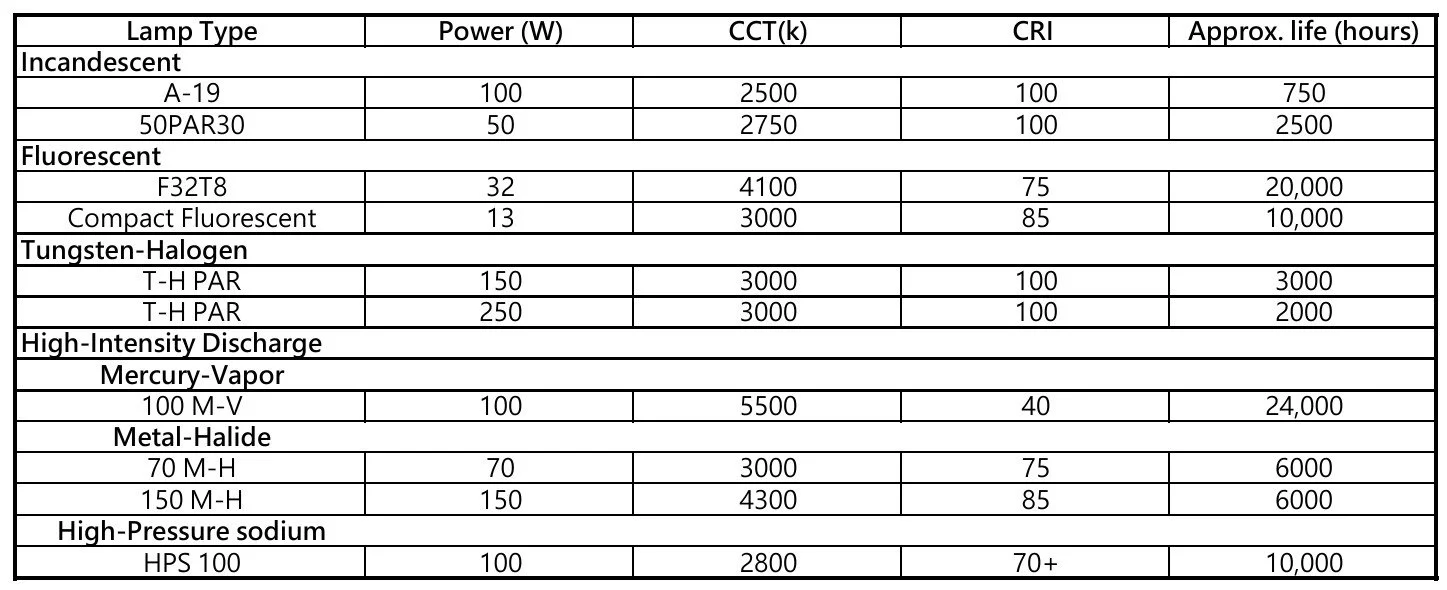
Characteristics of Lighting Source (Source reference: ARE Review Manual, by Professional Publications, Inc)
CRI & CCT
Two essential measurements telling us what our environment might "look" like are CRI and CCT.
CRI stands for "Color Rendering Index." It is a quantitative assessment that indicates how faithfully the lighting source reveals the colors of various objects compared to a natural light setting. This index ranges from 0-100; the higher the CRI number, the more it renders color faithfully and close to natural daylight.
A perfect 100 indicates that colors under the light source appear the same as they would under natural sunlight, since its light spectrum closely approximates a blackbody radiator.
CCT stands for "Correlated Color Temperature. " It is essentially a way to measure how the yellow (warm) or blue (cold) hue of the light emitted from a light bulb. It is estimated with degrees of Kelvin, ranging from 1700K to 6500K. The lower the number, the warmer it appears.
A little science behind the light bulbs
Generally speaking, incandescent light has a color temperature range from 2700K to 3100K. They have the best color rendering effect, which is almost close to 100 CRI. Their light output can also be easily controlled with reflectors and lenses.
An incandescent lamp consists of a tungsten filament placed within a sealed bulb with an inert gas. It produces light when electricity passes through the filament. They are manufactured in a wide variety of shapes, sizes, and wattages.
On the other hand, the tungsten halogen light is produced by the incandescence of the filament with a small amount of halogen gas. This leads to the filament burning under higher pressure and temperature. To resist the operational heat, the tungsten-halogen bulb uses a quartz capsule to contain the light, which is much smaller than a standard incandescent bulb. Due to their compact and directional features, jewellers favor them for their intricate jewellery inspection and tasks.
How about LED,light-emitting diodes (LED), you might have wondered. Unlike incandescents, LEDs produce light through a process called electroluminescence, which occurs in a semiconductor material when electrons and holes recombine at a p-n junction. A larger band gap produces higher-energy photons (shorter wavelengths, e.g., blue or green), and a smaller band gap produces lower-energy photons (longer wavelengths, e.g., red or infrared). Therefore, it can provide lighting with various color temperatures. Also, LED's chip accelerates and wears on the semiconductors and phosphor layers. This results in the light output slowly decreasing over its operational life. Their gradual degradation in brightness also influences the LED's CRI value.
By the way…
If you like to use Hazel's card to enhance your "place" related knowledge and memory, you might also like: