
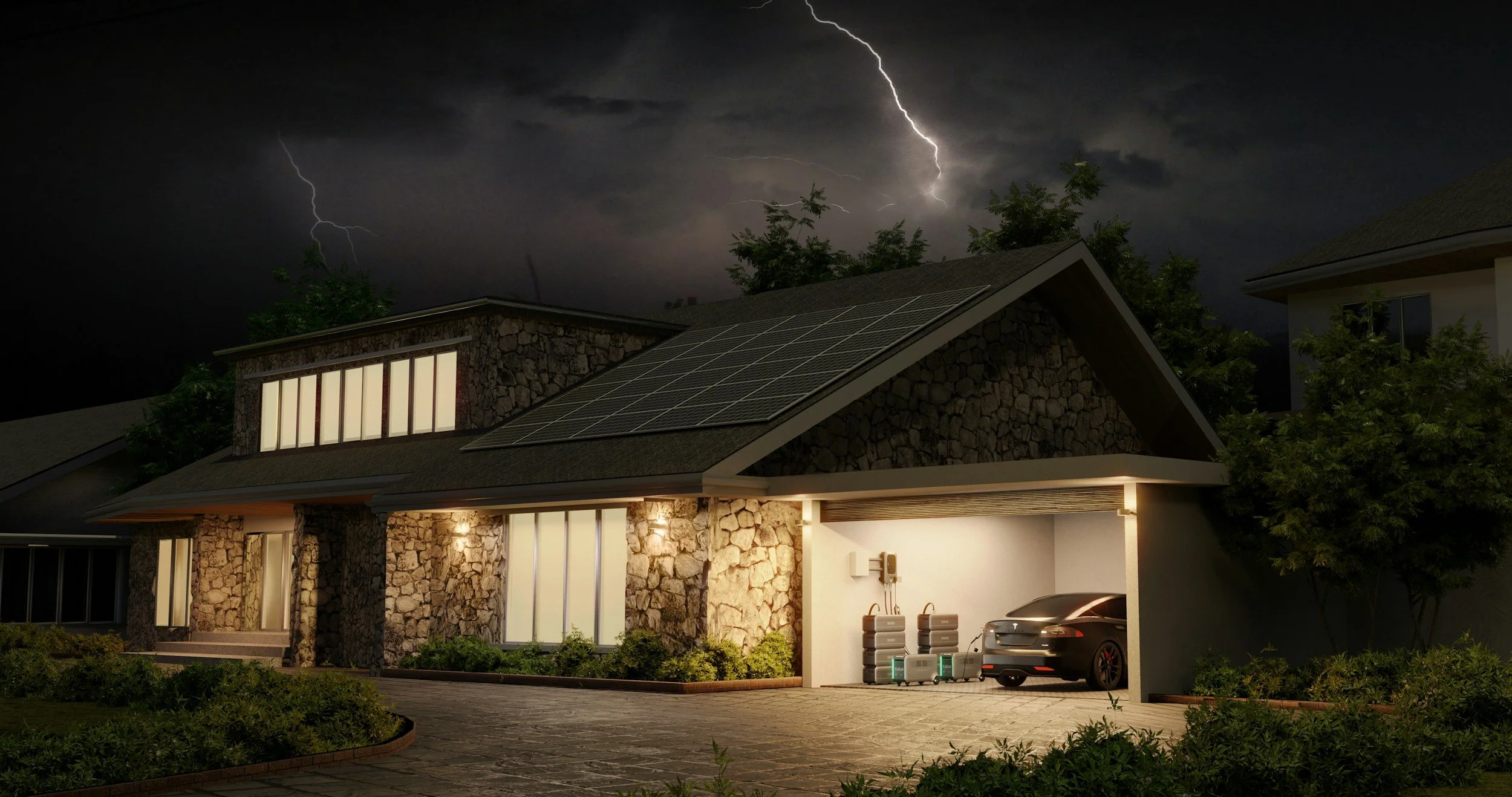
Many homeowners are excited about installing alternative energy system to power their home. However, they often overlooked the importance of the energy storage system (battery) and the priority of design and installation.
There are myths regarding existing batteries:
Installing batteries means the homeowner can live off the grid
Having batteries means complete electrification.
Using batteries to power the entire house.
Technologies change, so the physics of batteries change too.
So, how do we design a suitable energy storage system for our homes? Here are steps to take before purchasing batteries
I.Define the load
First, we need to define the current house load. "Load" means the total amount of electricity used by all devices, appliances, and lighting in our homes. That number represents the demand side of a home's energy equation. Homeowners are encouraged to perform a load analysis to get the right size of the battery system. We can use monitoring devices or historical utility data (from past bills) to get an idea of the house's energy usage.
Here are some examples:
Fridge-- A typical household refrigerator consumes an average of 150 to 200 running watts due to its compressor cycles. This translates to 1 to 2 kilowatt-hours per day.
Air Conditioner-- There are a variety of AC units on the market, and their energy consumption largely depends on the type, size, and efficiency.
A window unit could have 500-1500 running watts, and offers as low as 5000BTU to as much as 12,000 BTU for a room. That translates to 4 to 12 kilowatt-hours per day.
A portable unit could consume from 700 to 1600 watts per hour, depending on the BTUs they offer, which can lead to 5 to 13 kilowatt-hours per day. (If the unit runs for a minimum of 8 hours per day)
Generally speaking, we need 20 to 25 BTU per square foot. For a small room that is less than 300 square feet, a unit that ranges 5000-8000BTU is more than enough. For a room larger than 700 square feet (such as the size of a basement in most residential settings), we might need to pick one that offers more than 14,000 BTU to meet our comfort needs.
A mini-splits unit could range from 800 to 2500 watts per zone, and we can expect to spend at least 6.5 to 20 kilowatt-hours per day, depending on which zone we stay.
The output wattage of the unit is not only associated with the size of the zone but also more related to the efficiency of the unit. How efficient the mini-split unit is depends on its SEER rating. SEER is a ratio of the total cooling output over a typical cooling season to the total input energy in watt-hours. (see the equation below)
SEER = Total Seasonal BTUs output/Total Watt-hours Consumed. The higher the SEER rating, the more energy-efficient the heat pump is. The same mini-split unit that offers 9000 BTU cooling load, a 17 SEER2 unit can use up to 750 watts per hour, and a 23 SEER unit can use about 630 watts per hour.
A Central AC unit often runs 3000-5000 watts. Central AC offers a cooling load of more than 1 ton (12,000BTU). Their units typically range from 1 to 5 tons. A 3-ton central AC unit (16 SEER) consumes about 2250 watts during operation, and a 5-ton unit averages 3750 watts per hour, which translates to 30 kilowatt-hours per day and about 900 kilowatt-hours per month. (if the unit runs continuously for 8 hours throughout the day).
Coffee maker: There are a variety of coffee makers. The drip coffee maker uses the least energy per serving, and an Espresso machine consumes the most per serving.
PS. To find out exactly how much energy your appliances consume, check their energy guide labels or find the model number to look up their specification online. For example, the fridge I use has a 634kwh consumption per year, which translates to 1.73kwh for 24 hours.
II.Qualify Energy and Power
Energy = Power x Time.
Power = Energy/Time
Time is a critical consideration because of how and when the energy is generated, and when the battery will kick in and discharge during a typical day. Understand how the appliance's usage over time helps us to choose the right size and type of battery. For example, a typical lithium battery is likely to stay 20%-80% charged, and normally has 5000-6000 cycles throughout its life span. If a home's appliances aggregate their usage during a period of time, the battery can soon reach its 20% status and no longer feed into the power system. Therefore, if the battery is a typical lithium type, we have to size the system a little bit more to avoid the battery reaching a stage that is less than 20% charged.
III. Size the System
The reason why homeowners need to properly size the system is that the value of additional power system (solar panel in most residential applications) relies on solving the specific energy consumption of a home, and we need to begin with sizing the inverter and the battery.
Having that in mind, we need to collect information about appliances, such as:
startup load
load stacking
continuous vs. peak rate
battery and system limits
Sizing the Inverter, Get to know the appliances.
An inverter is a critical component in the energy system. It converts the raw Direct Current (DC) generated by solar panels into Alternating Current (AC). AC is the standard type of power used by typical home appliances and the electrical grid. For example, if an existing battery inverter only offers 40 amps, and the newly installed AC unit requires 70 amps to start. The battery will shut down when the air conditioning unit is turned on.
Having a properly sized system, the home can be resilient during the outage. It is also easy for homeowners to manage the time of use rate and maximize the energy consumption of the home.
Sizing the battery, Plan for the reality.
We all know what a battery is. However, when talking about "designing the system," we also have to consider aspects of a battery bank. Paying attention to the battery's usable capacity, its power output limit, recharge window, and load timing could help us make a better decision. For example, in some situations, the battery might have high power, low capacity to power an entire home or heavy machinery for a few minutes, then the battery's power drains quickly. In other scenarios, a battery might run only a light fixture or two but can keep them on for days or weeks.
Thus, having a proper intake of the living style of a property is important to get the right batter for the home.
Final takeaways
The value of having alternative energy relies on solving a specific problem. Homeowners should not use house size as a metric to select the energy storage system or evaluate how the system performs. The square footage of a home is irrelevant to the energy needed for the property (and the homeowners). We all need to be more prudent before making the purchase, as the design and installation errors are more often than the equipment's failure. Through a thorough understanding of our current lifestyle, we can balance the cost of the system against desired comfort and level up the resilience of our homes.
Notes and reference:
For more in-depth information on how the usage of a battery relates to the usage of a home, check out this video, Designing the Battery-Powered Home (35:30), provided by the GreenHomeInstitute.