

Many states have adopted and updated their Statewide Fire Prevention Code in recent years and expect the code to be complied with by 2033. I often feel perplexed when facing such an issue in the community I live in. It reminded me to go back to this video taught by Stewart Hicks.
Do you remember the Los Angeles fire in the Pacific Palisades neighborhood last year? The fire destroyed over 13,000 homes and caused billions of dollars in damage. Looking over the ashes, there was only one house that survived- the house on Iliff Street. It is a single-family house designed by architect Greg Chasen and was completed in 2023.
The house is a modern-style home situated in a 50' by 110' lot. Many press outlets praise the architect's defensible design strategy and innovative techniques. Hicks also brought up the point that homeowners should not hang up on a home's traditional looks or a neighborhood's historical charm. Instead, homeowners should focus on the safety aspects of a house, which often leads to a sleek, aloof look of a modern-style home.
Yet, does the look and style of a home really dictate how safe a home can be? I cannot stop asking myself. After tirelessly contemplating this question, I realized the answer could be narrowed down to Table R302.1, R904, and R905 of the International Residential Code.
The architect cleared out all vegetation around the house to eliminate the spread of flame
Los Angeles was classified as Climate Zone 3 (3B/3C) according to the IECC (Figure C301.1 Climate Zones). Many homes in Pacific Palisades are designed in the Spanish Colonial Style. Presumably, one was due to its historical context, the other was because of its warm coastal climate, similar to Andalucia in Spain.
While it is true that bushes are flammable and cause fire. Andalucia houses often use terracotta tiles, not only for interior use, but also extend the pavement to the outdoors. A French drain is also one of the essential building elements. According to IRC 405.1, it is required to install the French drains around the concrete or masonry foundation. Not only does it help manage stormwater runoff, but it also retains a balanced hydrostatic pressure at the foundation. It is typical to cover the drain with gravel or crushed stone to keep the ground surface permeable. Creatively matching these two traditional elements around the house and planting a minimum of 3 feet away from the house's exterior wall would also be a defensible strategy to have a fire-resistant feature and keep neighborhood charm.
The three-foot minimum distance is borrowed from the guideline of IRC Table 302.1 (2). "The exterior wall does not need to be fire-rated if it is 3 feet away from the lot line." Whether the existing house is equipped with a sprinkler system or not, as long as the landscape sprinkler system is installed in the yard, the homeowner can still enjoy the lush landscape as they prefer. Adding fire sprinkler heads to an existing landscape would do the same safety job when the garden bushes catch fire. However, ensure you separate the irrigation network and fire suppression network even in the outdoor field, as the water source for feeding the irrigation system and fire suppression system are different.
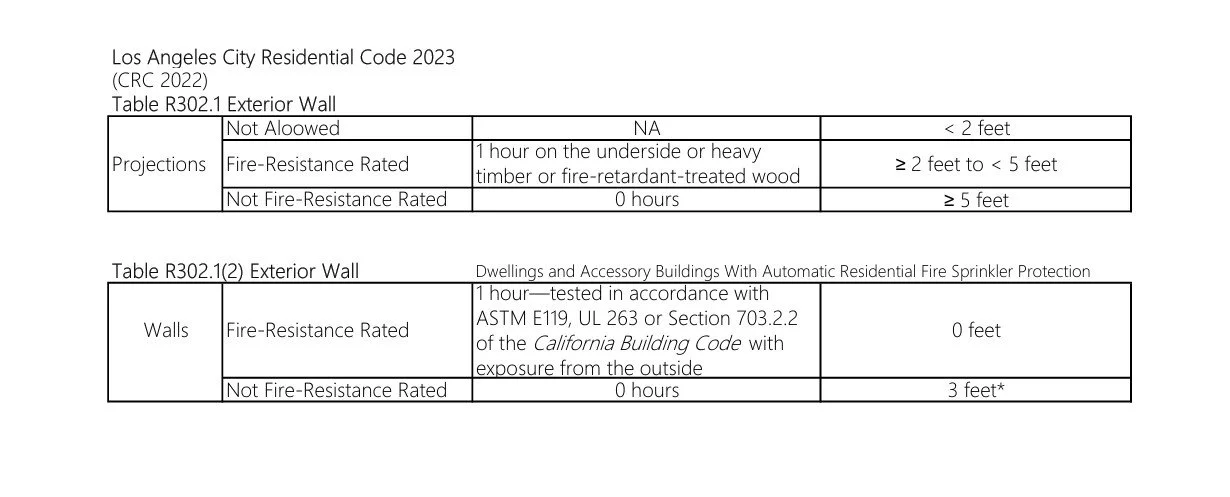
Source: UpCode. When implimenting such provision, make sure to double rech the requirement with note(*) at the bottom of the table.
The architect eliminated the traditional eave, side vents, and roof vents to avoid conflagration
According to Hicks, many local homes in Pacific Palisades have extended eaves, which make conflagration inevitable. These existing houses also have many vents, which increase the chance of airborne embers landing inside the building openings.
An extended projected eave might be too close to the property line and catch sparks from the neighbor's property. However, according to IRC Table R302.1(1), if the lot width allows, homeowners can certainly keep the eave feature as long as the eave edge maintains the required fire separation distance: meaning, keep the edge of any eave 5 feet away from the lot line. This wildfire defensible strategy can be easily achieved, as cities or local planning departments already have a minimum setback requirement for each zone. These required setback distances are often greater than the fire separation distance mandated in IRC.
If the lot width is narrow and the edge of the roof is too close to a lot line, homeowners have many fire-rated materials to select from. For example, in IRC 902 and 904, one of the Class A fire-rated roof assemblies includes clay or concrete roof tile installed on noncombustible framing. And these roof materials won't compromise the historic look of a Pacific Palisades home. If the homeowner can keep the tile roof and replace the deck with a noncombustible material, they can also reach the charming look they desire.
Traditionally, Spanish colonial architecture tends to use inner court, loggia, and patio doors to reach the desired lighting and ventilation. They typically aren't designed with an attic. The interior of the top floor is often exposed to the roof rafters to gain the height of the space. Therefore, it is unlikely to spot air vents on the exterior or at the soffit as much as we see them on America's traditional cottages.
Economics of 750 Iliff Street
It looks like having a fire-resistant feature won't necessarily compromise the look and feel of a neighborhood's character. So, what's the significance of this modern style, fire-buster home that sits on Iliff Street?
750 Iliff Street certainly gives us an economical and efficient solution for defeating wildfires in a contextualized neighborhood. That house is modularized and panelized per its main building material (5/8" Type X gypsum board, for instance). It also shows that it can be economical to have fire-resistant material within an average household budget. A fire-rated metal roof is priced between a typical asphalt shingle and a traditional clay tile roof. Moreover, imagine how challenging it might be to find a fire-proof substitution for the wood frame components exposed at the exterior. It could also be costly to make a deck, fascia, and rafter out of noncombustible material for the sake of maintaining historic character.
What's Next?
So go back to Hick's original question: Should we trade historic charm for safety? Should we rebuild exactly as before, or rethink the entire community when the next blaze is only a matter of time?
My answer would "ReThink" and “think twice”. As the building code progresses every triennial cycle, we can never build the same as before. On the other hand, we also don't have to compromise our lives, safety, and well-being by living in an outdated home without any safety measures.
According to the National Association of Home Builders' study, the average cost of building a house is around $162 per square foot. Based on this article published by HOMECOST, presumably the fire-resistant home in the Pacific Palisades would cost a higher-end construction fee to build ($430 per square foot in the state of California). This thirty four hundred square feet house would cost more than 1.5 million to build in 2026. Plus, this number does not include the demolition of the existing structure, nor the building permit fee and site works.
How much do you normally spend on repair and maintenance of your home? My thought is that properly retrofitting our current home is certainly a good investment for our loved ones and for those living around us.
By the way…
1.Below is my calculation of estimating the construction cost of 750 Iliff Street, with California Construction Cost Index CCCI consideration.
3400 square foot x $430 per square foot =$1,462,000
$1,462,000 (as in 2023) x 121982/113353 (CA construction cost index)= $1,573,294
2. Side notes on the cost of roofing material, provided by Roofing Calculator
Asphalt shingle roofs generally cost between $3.40 to $5.95 per square foot.
Clay tile roofs typically cost between $9.09 to $12.29 per square foot.
Fire-resistant metal roofs typically cost between $6.0 to $24.50 per square foot. Among them, a Standing Seam Metal Roof costs about $18.11 to $24.50 per square foot.
3. There are various types of fire sprinkler heads: pendent heads, upright heads, sidewall heads, and concealed heads. Their costs also vary by type. Among them, upright sprinkler heads have a spray pattern similar to that of a pendent sprinkler head. Conventionally speaking, the difference is that a pendent head is used in the area where the ceiling is accessible (so a technician can open the ceiling and repair pipes), while upright sprinkler heads are commonly used where the ceiling is not accessible. When using the fire sprinkler heads in a landscape as the fire defense mechanism, presumably, both sprinkler heads would work; it's just a matter of the sprinkler heads' cost and availability in the local market when making the decision. Choosing the type of sprinkler pipe is typically based on local weather and whether the space is heated and conditioned. If the location is prone to freezing, use dry pipe; otherwise, wet pipe could do a good job on outdoor landscape applications.
I found this video by Deconstructed that illustrates very well how a fire sprinkler head works, and you can always get a professional recommendation once you talk to your local fire protection engineers.
Last update 7. 27. 2026.