
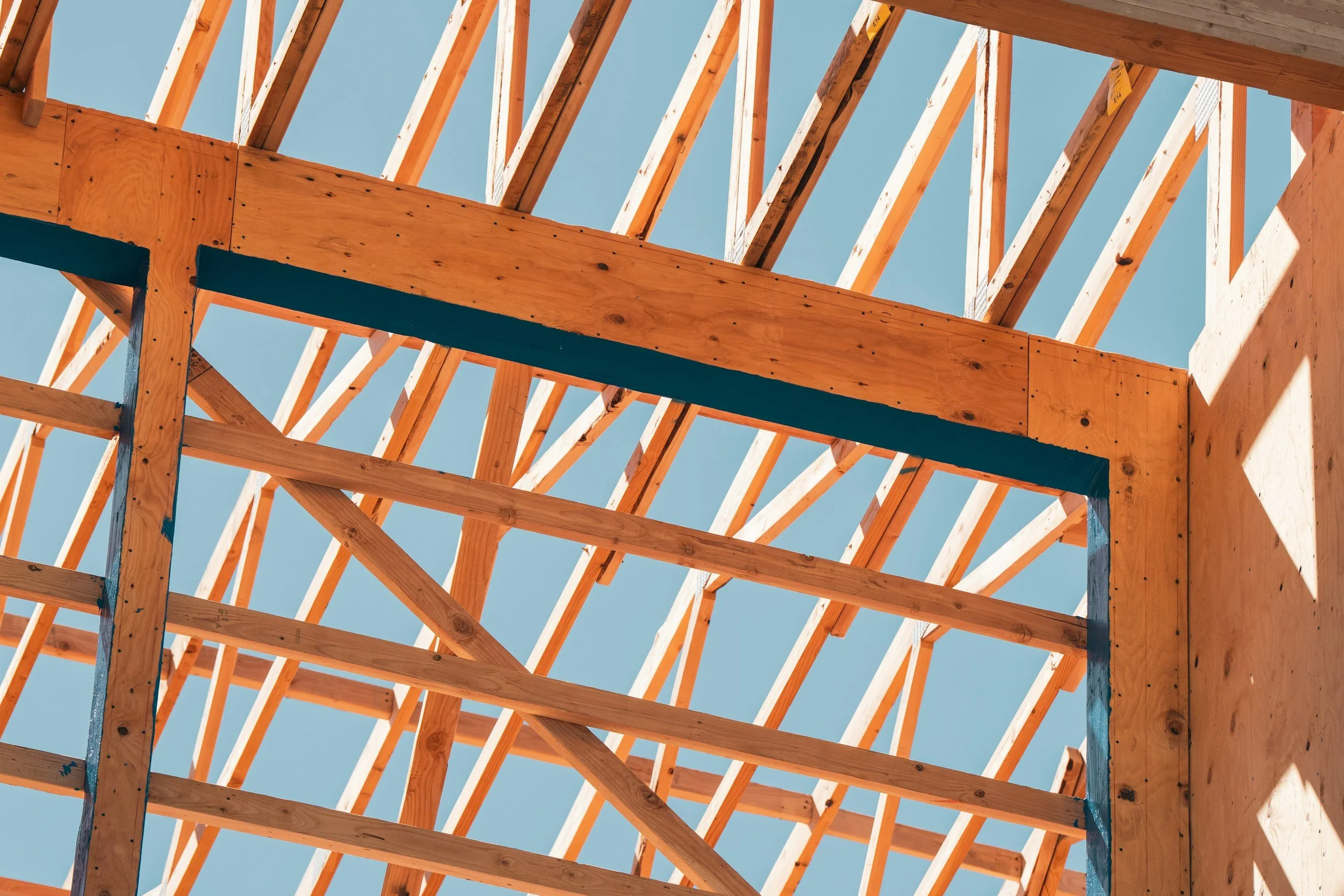
Wood, the essential building material
Wood is favored as both a building structural and finishing material. Approximately nine out of ten buildings constructed in the United States are framed with wood. That includes both single-family and multi-family residential buildings. In recent years, after construction type IV-C was first introduced in the 2021 International Building Code, a large percentage of commercial buildings have also constructed in wood,.
Why does wood shrink?
Wood is a hygroscopic material that absorbs and releases moisture. Therefore, wood frames change their dimensions based on such natural characteristics. Wood remains dimensionally stable above its fiber saturation point (FSP); the shrinkage only occurs when the moisture content (MC) of a lumber in service is far below FSP. Once the lumber reaches the state below its FSP, the shrinkage occurs perpendicular to the grain.
Typically, 1% of shrinkage in cross-section for every 4% MC change from 0 to 30. This translates to a dimensional change of 0.0025 inches per inch of cross-sectional dimension.
Why does the shrinkage in wood structure matter?
Multi-story wood buildings experience aggregated vertical shrinkage, which can affect finishes, windows and doors, the MEP system, and structural integrity.
The failure caused by wood shrinkage can be controlled or avoided when we have more comprehensive knowledge of wood science and material detailing.
Minimize Wood Shrinkage
Structural connection: Shrinkage occurs in the cross-grain dimension of a wood member. Therefore, using a larger fastener installed near the top and bottom of a wood member can minimize the splits and cracks.
Building envelope issues: building envelopes often consist of various materials, and significant shrinkage may occur due to different material characteristics. such as:
Brick: expand due to moisture or thermal changes
Steel/Cast iron/ PVC: shrink due to moisture change
Masonry and cement: shrink much less.
MEP system damage: As noted above, wood, brick, and masonry are subject to movement, while PVC pipes seldom shrink. Thus, to reduce the wood shrinkage impact on damage, it is best to wait as long as possible to install vertical runs after completion of framing. This allows the structural frame come closer to its EMC and allows more deadload on the structure before MEP installation.
Multi-story risk:
1.Rreducing the total thickness of cross-grain wood members in the vertical load path can minimize shrinkage and its effect. For example, changing the platform framing to balloon framing, so the upper floor joists are hung from the wall, can significantly minimize per-floor and cumulative building shrinkage.
2.Cumulative shrinkage may occur at the shafts and atrium where multi-story wall finishes are continuously installed directly to the wood framing. Thus, installing expansion joints between each gypsum wall board panel allows the total building shrinkage to be accommodated over the height of the shaft or atrium.
Key terms you Need to Know
Shrinkage Zone: A shrinkage zone is a specific area in a material or structure where contraction occurs as a result of cooling, solidification, or other physical changes.
Dry Lumber- Lumber dries to a maximum moisture content of 19 percent.
Equilibrium Moisture Content (EMC): the moisture level at which a material neither gains nor loses moisture when in contact with air at a specific temperature and relative humidity.
Heat Treated (HT): A wood product that has been heated in a closed chamber until it achieves a minimum core temperature of 132.8F for a minimum of 30 minutes.
Kiln dried (KD): Lumber that has been seasoned in a chamber to a predetermined moisture content by applying heat.
Moisture content (MC): the weight of the water in a lumber expressed as a percentage of the weight of the piece after being oven dried.
Fiber saturation point (FSP): the point in drying wood at which all free moisture has been removed from the cell itself while the cell wall remains saturated with absorbed moisture.
What's the takeaway?
Shrinkage in wood-framed buildings is not a new phenomenon, nor is it overly complex to address. It requires an awareness of how and why wood shrinks to select and specify proper material and detail on the job site to accommodate this change.
It is also critical to understand the science behind shrinkage so designers can look for the right shop drawings to adhere to construction details on the jobsite. Proper detail leads to proper installation, and a successful building performance is what we can eventually expect.
Notes and Reference:
More information please refer to WoodWorks | Wood Products Council
IBC Chapter 23 mainly is the chapter focus on Wood. We can tell shrinkage is the essential consideration when using wood construction. The significance of such consideration is refect on 2303.7 “Consideration shall be given in design for the effects of wood cross-grain dimensional changes that occur as a result of changes in the wood moisture content after installation” and 2304.3 “…unless an analysis satisfactory to the building official shows that shrinkage of the wood framing will not have adverse effects on the structure or any plumbing, electrical or mechanical systems or other equipment installed therein due to excessive shrinkage or differential movements caused by shrinkage.”